
 21, Jul 2026
- By Joel Jonah
- Nigerian Real Estate Market Insights
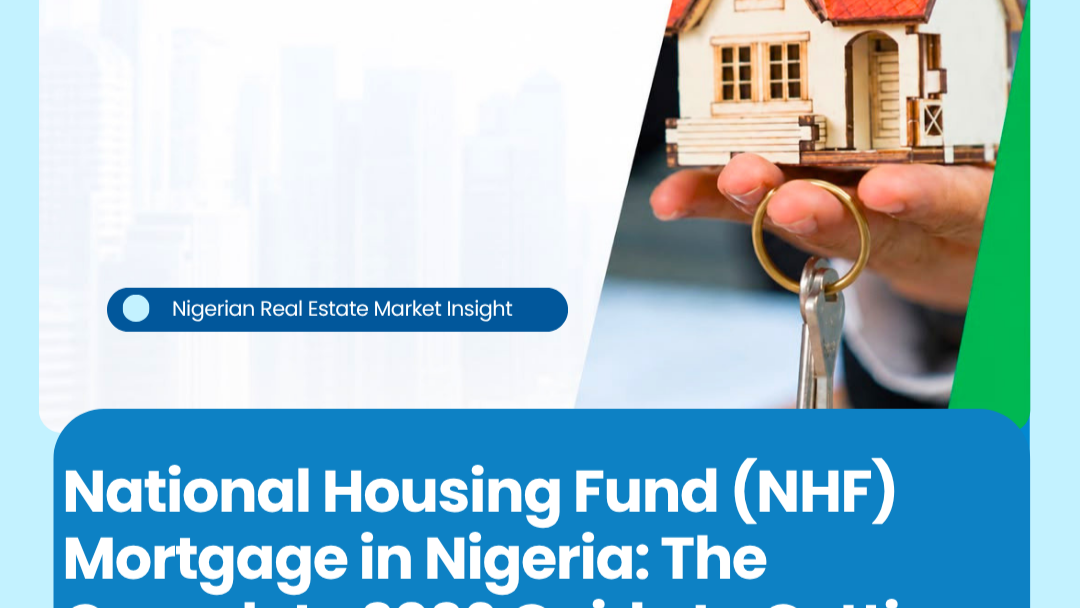
National Housing Fund (NHF) Mortgage in Nigeria: The Complete 2026 Guide to Getting a 6% Home Loan
For many Nigerians, owning a home is a lifelong dream. Unfortunately, commercial mortgage interest rates—often ranging from 18% to 24%—have made homeownership unaffordable for the average income earner.
The National Housing Fund (NHF) changes that narrative.
Managed by the Federal Mortgage Bank of Nigeria (FMBN), the NHF gives eligible contributors access to mortgages of up to ₦50 million at a fixed 6% annual interest rate, repayable over as long as 30 years.
It is arguably the most affordable mortgage financing option in Nigeria.
Yet, while millions contribute monthly, relatively few successfully obtain the loan. The reason is simple: contributing to the NHF is easy; successfully navigating the mortgage application process is where many people struggle.
This guide explains exactly how the scheme works, who qualifies, how much you can borrow, the documents required, and how to improve your chances of approval.
What is the National Housing Fund (NHF)?
The National Housing Fund (NHF) is a government-backed housing finance scheme established by Act No. 3 of 1992 to make homeownership more affordable for Nigerians.
Every eligible worker contributes 2.5% of their basic monthly salary into the Fund. Self-employed individuals can also register and make voluntary contributions directly through FMBN.
After contributing continuously for at least six months, contributors become eligible to apply for an NHF mortgage through an accredited Primary Mortgage Bank (PMB).
It is important to understand that the NHF itself does not issue mortgages directly. Instead, FMBN pools contributions from millions of Nigerians, lends the funds to accredited PMBs at 4%, and the PMBs provide mortgages to contributors at a fixed 6% interest rate, using the property as security.
Why the NHF Mortgage Stands Out
The biggest advantage of the NHF mortgage is its affordability.
Unlike commercial mortgage loans whose interest rates change with market conditions, the NHF interest rate remains fixed at 6% throughout the life of the loan.
Combined with repayment periods of up to 30 years (subject to retirement age), this significantly reduces monthly repayments and makes homeownership achievable for many middle-income earners.
For example, a ₦20 million mortgage repaid over 20 years would attract an estimated monthly repayment of about ₦143,000 at 6% interest. The same loan at an 18% commercial rate could exceed ₦300,000 per month, while a 24% loan could surpass ₦400,000 monthly.
Over the life of the loan, that difference can amount to tens of millions of naira in interest savings.
How Much Can You Borrow?
Although the NHF now offers mortgages of up to ₦50 million, the amount you qualify for depends on three key factors:
Your monthly income
The value of the property
Your age
The most important rule is affordability.
Your monthly mortgage repayment cannot exceed one-third of your monthly income, making your salary the primary determinant of your loan amount.
In addition, the NHF generally finances up to 90% of the property's value, meaning you'll be required to provide an equity contribution for the balance.
Since repayment must end before retirement (typically age 60), younger applicants often qualify for larger loans because they have longer repayment periods.
Who Can Apply?
To qualify for an NHF mortgage, you must:
i. Be a Nigerian citizen aged 18 years or above.
ii. Have contributed to the NHF continuously for at least six months.
iii. Have a regular and verifiable source of income.
iv. Be purchasing, building, renovating, or improving a residential property.
v. Ensure the property has a valid and registrable title.
The scheme is open to public servants, private-sector employees, self-employed professionals, traders, artisans, and other informal-sector workers who contribute to the Fund.
Documents You'll Need
Before beginning your application, ensure you have the following:
i. Completed NHF mortgage application form
ii. NHF registration details and contribution statement
iii. Recent payslips or proof of income
iv. Employer's confirmation letter (where applicable)
v. Tax Clearance Certificate
vi. Valid means of identification
vii. Passport photographs
viii. Property title documents (Certificate of Occupancy or equivalent)
ix. Valuation Report (for existing property) or approved building plans and Bills of Quantities (for construction)
Incomplete documentation remains one of the leading causes of delayed mortgage approvals.
How to Apply for an NHF Mortgage
The application process is relatively straightforward when properly understood.
Step 1: Register as an NHF Contributor
Employees are registered through their employers, while self-employed Nigerians can register directly with FMBN.
Once registered, you receive an NHF participation number.
Step 2: Contribute for at Least Six Months
You must maintain at least six months of continuous contributions before applying. It is advisable to monitor your contribution records regularly to ensure your employer is remitting deductions correctly.
Step 3: Choose an Accredited Primary Mortgage Bank
Applications are submitted through accredited PMBs, not directly to FMBN.
Choosing an experienced PMB can significantly improve your application's processing time.
Step 4: Identify Your Property and Submit Your Documents
Once you've selected a property with a clean and registrable title, submit your application together with all required supporting documents.
Step 5: Pay Your Equity Contribution
The NHF generally finances up to 90% of the property's value. You'll be required to provide the remaining equity contribution before disbursement.
Step 6: Loan Approval and Disbursement
After verifying your NHF contributions, income, affordability, and property documents, FMBN approves the loan and releases the funds through your PMB. Repayment then begins according to the agreed mortgage schedule.
Final Thoughts
The National Housing Fund remains Nigeria's most affordable pathway to homeownership. A fixed 6% interest rate, repayment periods of up to 30 years, and loan limits of ₦50 million make it a far more accessible option than conventional mortgage financing.
While the application process requires patience and proper documentation, the long-term financial benefits are substantial. The key is preparation: ensure your NHF contributions are up to date, choose an experienced Primary Mortgage Bank, and verify that the property you're buying has a clean, legally registrable title.
For Nigerians looking to buy, build, or renovate a home, the NHF mortgage remains one of the smartest financing options available today.
At Tech City Real Estate Ltd., we simplify the entire process. Our team works closely with qualified contributors to guide them through every stage of the NHF mortgage application—from property selection and documentation to mortgage processing—helping clients secure financing as smoothly and efficiently as possible.
Whether you're buying your first home, building your dream house, or investing in residential property, Tech City is committed to making your journey to homeownership seamless, transparent, and stress-free.
📞 Contact Tech City Real Estate Ltd Today
KM 25, Suite 14, DDS Shopping Mall, Airport Road, Rukpokwu, Port Harcourt, Rivers State, Nigeria
Tel: +234 916 213 9345 | +234 904 676 8832
Email: info@techcityrealestatecompany.com
Website: www.techcityrealestatecompany.com
Recent Post

Guide for Couples: How to Properly Write Your Names on Property Documents in Nigeria

The Future of Real Estate in Port Harcourt 5 Trends Shaping the Market in 2026 — And How Tech City Real Estate Is Staying Ahead

Tech City Launches the First Realtor’s Platform That Pays Instant Commission to Sales Partners.
Subscribe To Our Newsletter
It is a long established fact that a reader will be distracted by the readable content of a page when looking at its layout.
